
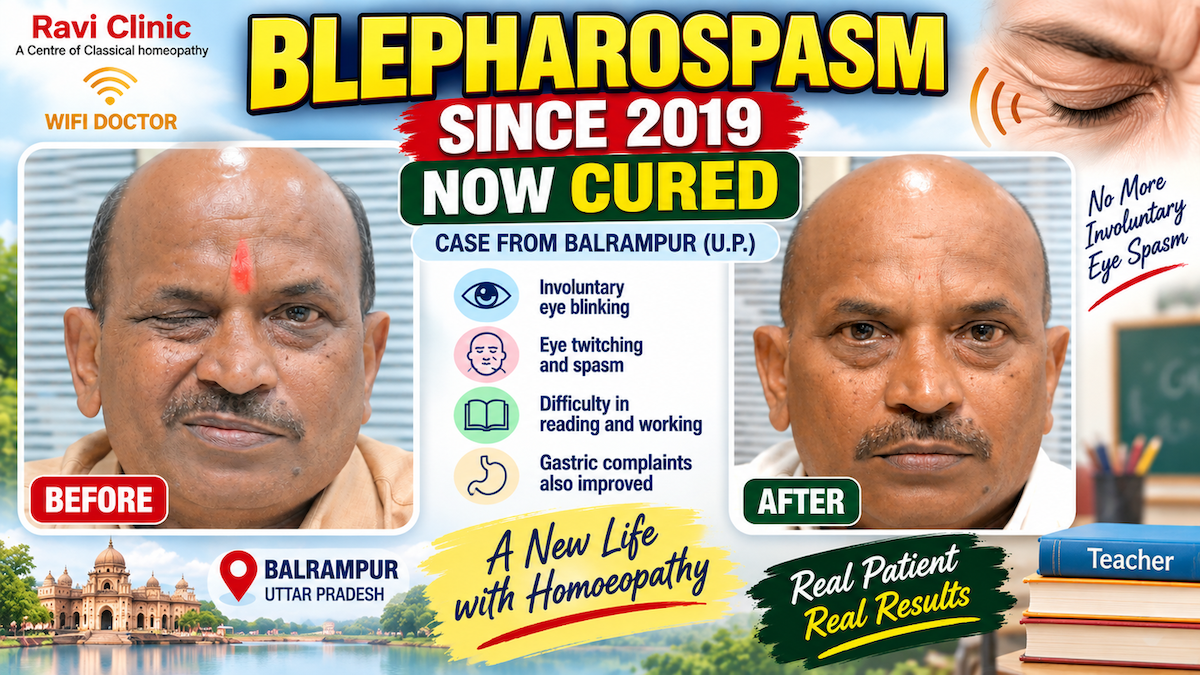
Let me share another interesting case of Blepharospasm from Balrampur, Uttar Pradesh.
I had known this patient personally, as he lived in the same colony where I lived in Balrampur.
In 2019, he contacted me and described his problem. At that time, I identified the condition as blepharospasm and advised him to visit my clinic in Lucknow for a detailed consultation. However, as he was working as a teacher in the Basic Education Department and was unable to make the visit, he did not come for treatment at that time.
Over the years, his condition gradually became more troublesome. By 2026, the spasmodic closure of his eyes had become severe enough to interfere with his ability to read and teach at school. He also reported that the condition frequently put him in awkward situations and made him feel embarrassed in public.
He finally visited my clinic in Lucknow, where a detailed case history was taken. Based on the symptoms, treatment was started using the medicine-transmission method, with his hair inserted into Staphysagria 0/1.
Follow-up – 15 April 2026
During a telephone follow-up, he reported no significant relief from the eye spasms and was becoming increasingly discouraged.
I therefore re-studied his case and reviewed the symptom picture. Based on the updated assessment, the medicine transmission was changed from Staphysagria 0/1 to Ignatia 0/1.
Follow-up – 6 May 2026
At the next telephone follow-up, he reported that the new medicine was having an effect. He was feeling considerably better, particularly regarding the pulling sensation and spasmodic symptoms around his eyes.
The medicine-transmission treatment was continued.
In this Zoom follow-up consultation, on 18 Aug 2026, I reviewed the patient’s progress after starting treatment for blepharospasm, characterized by involuntary squeezing and narrowing of the eyes.
When asked about his current eye condition, the patient reported that he was much better compared with his earlier condition and was able to carry out his routine work normally.
I specifically asked about the difficulty he had previously experienced with his eyes becoming tightly squeezed or narrowed. The patient confirmed that this problem had reduced significantly.
When asked to estimate the improvement, he reported approximately 30–40% reduction in the eye spasms compared with his earlier condition.
During the consultation, I also showed him the previous photograph on screen so that we could compare his earlier eye condition with his current status. He confirmed that the severe squeezing of the eyes that he had experienced earlier was no longer occurring to the same extent.
Follow-up – 20 September 2026
The patient again travelled from Balrampur to my Lucknow clinic for a follow-up.
On assessment, he reported remarkable improvement, and the blepharospasm was almost completely resolved.
This case illustrates the importance of individualised case analysis and reassessment when the initial prescription does not produce the expected response.
